 how-to
How to Load a Car Hauler Safely: Step-by-Step
Table of Contents
- Prepare Your Tow Vehicle, Trailer, and Loading Area
- Check Ground Clearance and Approach Angle
- Position and Stabilize the Car Hauler Trailer
- Align and Secure Loading Ramps
- Drive or Winch the Vehicle Onto the Trailer Slowly
- Achieve Proper Car Trailer Weight Distribution
- How to Strap a Car to a Trailer Correctly
- Car Hauler Loading Checklist and Final Safety Checks
- Frequently Asked Questions
Last Updated: October 18, 2026
Prepare Your Tow Vehicle, Trailer, and Loading Area
To load a car hauler safely, you must start before you ever position the vehicle. The foundation matters. A solid setup prevents accidents, protects your car, and keeps everyone safe.
Verify tow vehicle capacity and trailer ratings
Your tow vehicle must have the muscle to handle the load. Check your vehicle's owner manual for the maximum towing capacity. This number is non-negotiable.
Next, verify the car hauler's capacity. The trailer's tongue weight, gross vehicle weight rating (GVWR), and axle weight limits are printed on the trailer's VIN plate. These aren't suggestions.
Compare three numbers:
- Your vehicle's towing capacity
- The trailer's GVWR
- The weight of the car you're loading plus the trailer weight
All three must align. If your tow vehicle maxes out at 5,000 pounds and your loaded trailer weighs 6,500 pounds, stop. Do not proceed. Overloading causes brake failure, jack-knifing, and loss of control on the road.
Inspect the car hauler before loading
A damaged trailer becomes a liability the moment you load a vehicle onto it. Walk the entire trailer. Check for:
- Bent or cracked frame members
- Broken or missing D-rings and anchor points
- Damaged ramps or hitch connection
- Worn or bald tires
- Non-functional lights or brake issues
- Rust or corrosion that weakens structural integrity
If you're renting, inspect the equipment before you leave the rental lot. Document any damage with photos. A well-maintained car hauler is essential. Forney Trailer Rentals offers well-maintained and checked equipment, so you can focus on the loading process itself rather than worrying about trailer condition.
Set up on firm, level ground
Location matters. Never load on soft soil, gravel, or asphalt that's cracked or sloping. Soft ground causes the trailer to sink unevenly. Sloped ground throws weight distribution off balance.
Find a firm, level surface. Concrete or packed dirt works well. If the ground slopes slightly, position the trailer so the car will be loaded on the higher side. This helps with weight distribution and prevents the trailer from tipping.
Use wheel chocks behind the tow vehicle's rear wheels. This prevents rolling while you're working. Double-check that the parking brake is engaged.
Check Ground Clearance and Approach Angle
Before you drive the car onto the ramps, verify it will fit. Low-clearance vehicles need special attention.
Ground clearance is the distance between the car's lowest point and the ground. Sports cars, luxury sedans, and modified vehicles often have minimal clearance. Measure the distance from the car's front bumper to the ground.
Approach angle is the steepest angle a vehicle can climb without scraping. If your car has a 10-degree approach angle and the ramps create a 15-degree incline, the front bumper will hit the ramp.
Calculate the ramp angle using simple geometry. If the ramps are 8 feet long and rise 3 feet, divide 3 by 8. That's a 37-percent grade, or roughly 20 degrees. For most cars, this is too steep.
Lower the ramp angle by:
- Moving the trailer forward so the ramps extend further
- Using longer ramps if available
- Positioning the trailer on slightly higher ground
A gentle incline protects both the car and the ramps. Aim for angles under 15 degrees whenever possible.
Position and Stabilize the Car Hauler Trailer
A stable trailer is a safe trailer. Before you load, secure the trailer to the tow vehicle and the ground.
Connect the trailer to the tow vehicle's hitch. Ensure the hitch connection is tight. Bounce the trailer slightly to confirm it doesn't move.
Engage the trailer's parking brake if it has one. Lower the landing gear (the support leg at the front of the trailer) until it touches the ground firmly. The landing gear prevents the trailer from tipping backward when you load the car.
Check the trailer's level using a simple level tool. The trailer should sit flat, not tilted forward or backward. If it tilts, adjust the landing gear height.
Position wheel chocks in front of and behind the trailer's wheels if you have them. This prevents any rolling during the loading process.
Align and Secure Loading Ramps
Ramp alignment is critical. Misaligned ramps cause the car to load unevenly, which throws off weight distribution and creates safety hazards.
Position the ramps so they're parallel to each other and perpendicular to the trailer's length. The ramps should be centered on the trailer's width.
Secure the ramps to the trailer using ramp anchors or chains. The ramps must not shift when the car drives onto them.
Check that the ramps are fully seated against the trailer's loading platform. There should be no gaps between the ramp and the platform. Gaps cause the car's tires to catch and bounce, which destabilizes the load.
Test the ramp stability by applying pressure. Push down on the ramp with your body weight. It should not flex excessively or move. If it does, reposition and resecure.
Drive or Winch the Vehicle Onto the Trailer Slowly
Speed is your enemy here. To load a car hauler safely, use slow, controlled movement that prevents damage and keeps the load stable.
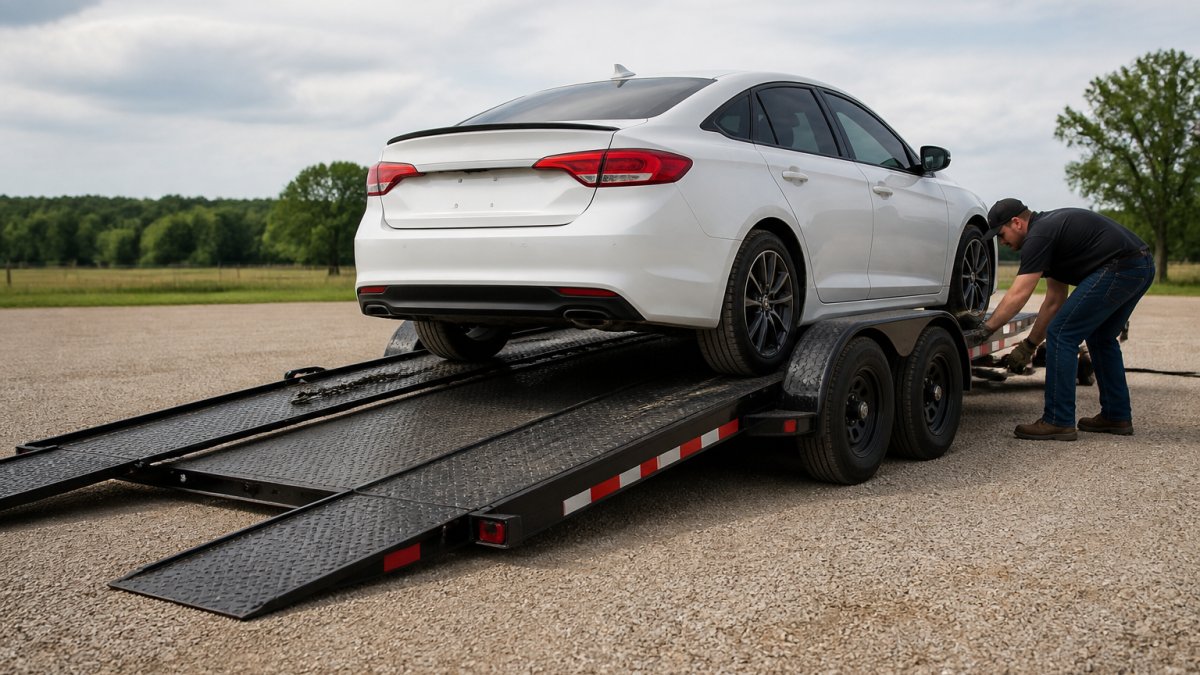
If the car is drivable, the driver should proceed slowly up the ramps. Maintain steady speed. Do not accelerate or brake suddenly.
Aim for the center of the trailer. The car should load straight, not at an angle.
If the car is not drivable, use a winch to pull it onto the trailer. Attach the winch cable to the frame member or a secure tie-down point on the car.
Winch slowly and steadily. Jerking or rushing causes the car to bounce or shift. A smooth, controlled pull keeps everything aligned.
Once the car is fully on the trailer, stop. Do not drive it further forward. Position it so the weight is balanced on the trailer.
Achieve Proper Car Trailer Weight Distribution
Weight distribution determines how the trailer handles on the road. Poor distribution causes swaying, brake issues, and loss of control.
Tongue weight is the downward force the trailer exerts on the tow vehicle's hitch. Proper tongue weight is 10 to 15 percent of the total trailer weight.
Position the car so more weight is toward the front of the trailer. This increases tongue weight and improves stability.
Check the weight distribution by observing the tow vehicle. The rear should squat slightly but not excessively. If the rear is compressed too much, reposition the car forward.
Use a weight distribution hitch if your tow vehicle is rated for one. This device transfers some of the trailer's weight to the tow vehicle's front axle, improving handling and braking.
How to Strap a Car to a Trailer Correctly
Straps are your final line of defense. They keep the car from shifting or tipping during transport. Improper strapping is a leading cause of transport accidents.
Identify tie-down points and anchor points
Tie-down points are secure locations on the car where you attach straps. Use the frame member or control arms. Never strap to bumpers, trim, or suspension components. These will break and fail.
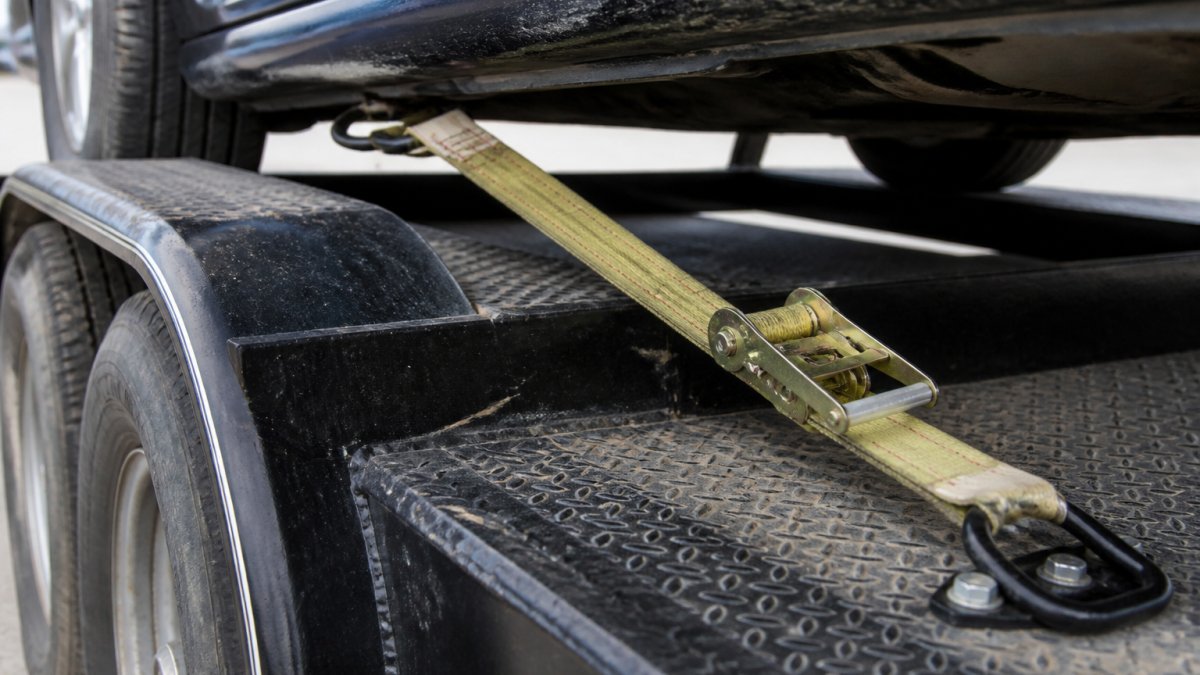
Anchor points are the D-rings or attachment points on the trailer. These are reinforced and designed to handle pulling forces. Use anchor points that are positioned to distribute the load evenly across the car.
Position anchor points at the car's four corners when possible. This creates balanced tension and prevents the car from rolling or shifting.
Choose the right straps and routing
Use wheel straps, axle straps, or ratchet straps. Each type has advantages.
Wheel straps wrap around the tire and wheel. They're easy to apply but can slip if not tensioned properly. Use them as secondary straps, not primary ones.
Axle straps attach to the suspension or axle. They're more secure than wheel straps and distribute force better. These are a solid choice for most vehicles.
Ratchet straps use a mechanical tensioner to tighten. They provide excellent holding power but require proper technique to avoid over-tightening, which can damage suspension components.
Route straps so they cross diagonally from the car's frame to the trailer's anchor points. This creates a triangle of force that stabilizes the car in all directions.
Use webbing that's at least 2 inches wide. Narrow webbing concentrates force and can damage the car's paint or frame.
Apply proper strap tension
Tension is the balance point. Too loose, and the car shifts. Too tight, and you damage the suspension or frame.
Tighten each strap until it's snug. You should not be able to move the car by hand. The car should feel locked in place.
Use a ratchet strap's mechanical advantage gradually. Tighten until you feel resistance, then give the handle two or three more full turns. Do not over-crank. If you're using significant force, you've gone too far.
Check all straps after 10 minutes of tightening. Webbing stretches slightly as it settles. Re-tighten if needed.
| Strap Type | Best Use | Tension Method | Pros | Cons |
|---|---|---|---|---|
| Wheel Straps | Secondary securing | Hand-tightened | Easy to apply | Can slip under load |
| Axle Straps | Primary securing | Hand or ratchet | Distributes force well | Requires suspension access |
| Ratchet Straps | Heavy-duty securing | Mechanical tensioner | Excellent holding power | Risk of over-tightening |
Car Hauler Loading Checklist and Final Safety Checks
Before you hit the road, verify everything one final time. A few minutes now prevents disasters later.
Pre-departure inspection
Walk around the loaded trailer. Verify:
- All four straps are tight and secure
- The car is centered on the trailer
- No part of the car overhangs the trailer edges
- Ramps are removed and secured
- All lights on the trailer are functional
- The hitch connection is tight
- Tire pressure on the tow vehicle and trailer is correct
- The parking brake is disengaged
Check that the car's doors and windows are closed. Open a window slightly to prevent pressure buildup during transport, but not enough for debris to enter.
Road-readiness verification
Before driving, test the brakes. Drive slowly in an empty parking lot. Apply the brakes gently and feel how the trailer responds. The trailer should slow smoothly without swaying or pulling to one side.
If the trailer sways or the brakes feel spongy, stop immediately. Recheck the strap tension and weight distribution.
Drive slowly for the first few miles. Watch the trailer in your mirrors. It should track straight behind the tow vehicle. If it drifts or sways, pull over safely and inspect the load.
On the highway, maintain steady speed. Avoid sudden acceleration or braking. Smooth, predictable driving keeps the load stable.
Stop every 50 miles to visually inspect the straps. Vibration and movement can loosen them. Re-tighten if needed.
Loading a car hauler safely requires attention to detail and respect for the process. Our transparent rental process and reliable trailers mean you can focus on what matters: securing your load properly and getting it to its destination safely. Book My Trailer today and load with confidence.
Frequently Asked Questions
How often should you check the straps when towing a car?
Check straps before departure, after the first 50 miles of driving, and every 100 miles thereafter during transport. Stop and inspect strap tension, routing, and anchor points for any loosening or wear. Many experienced haulers recheck straps at rest stops and fuel breaks. This frequent verification prevents load shift and ensures the vehicle remains secure throughout the journey.
What is the 60/40 rule for loading a trailer?
The 60/40 rule refers to weight distribution on a car hauler: ideally, 60% of the loaded trailer weight should rest over or forward of the axles, while 40% should sit behind them. This distribution minimizes tongue weight stress on your tow vehicle and improves stability. Proper weight distribution is critical for safe towing and reduces the risk of trailer sway or jackknifing on highways.
Where should the car sit on a car hauler?
Position the vehicle in the center of the trailer deck, aligned straight with the trailer's centerline. This centering distributes weight evenly across both wheel sets and maintains trailer balance. Avoid loading the car too far forward or backward, as this creates uneven tongue weight or rear-end drag. For dual-axle trailers, the vehicle should sit between the axles when possible to optimize stability.
What should I do if my vehicle has low ground clearance?
Measure your vehicle's ground clearance and approach angle before attempting to load. Low-clearance vehicles (sports cars, sedans) may require ramps with a shallower angle or winch assistance to avoid scraping the front bumper or undercarriage. Some car haulers offer adjustable ramps or oversize tire straps to accommodate low-clearance vehicles. If your vehicle's clearance is marginal, use a winch to control the loading speed and angle carefully.